Sea Caving in Mallorca: A Complete Guide to the Island's Coastal Caves
Everything you need to know about sea caving on Mallorca: what it actually involves, the geology behind it, where it happens, and how to plan a visit from Porto Cristo.
What Sea Caving Actually Involves
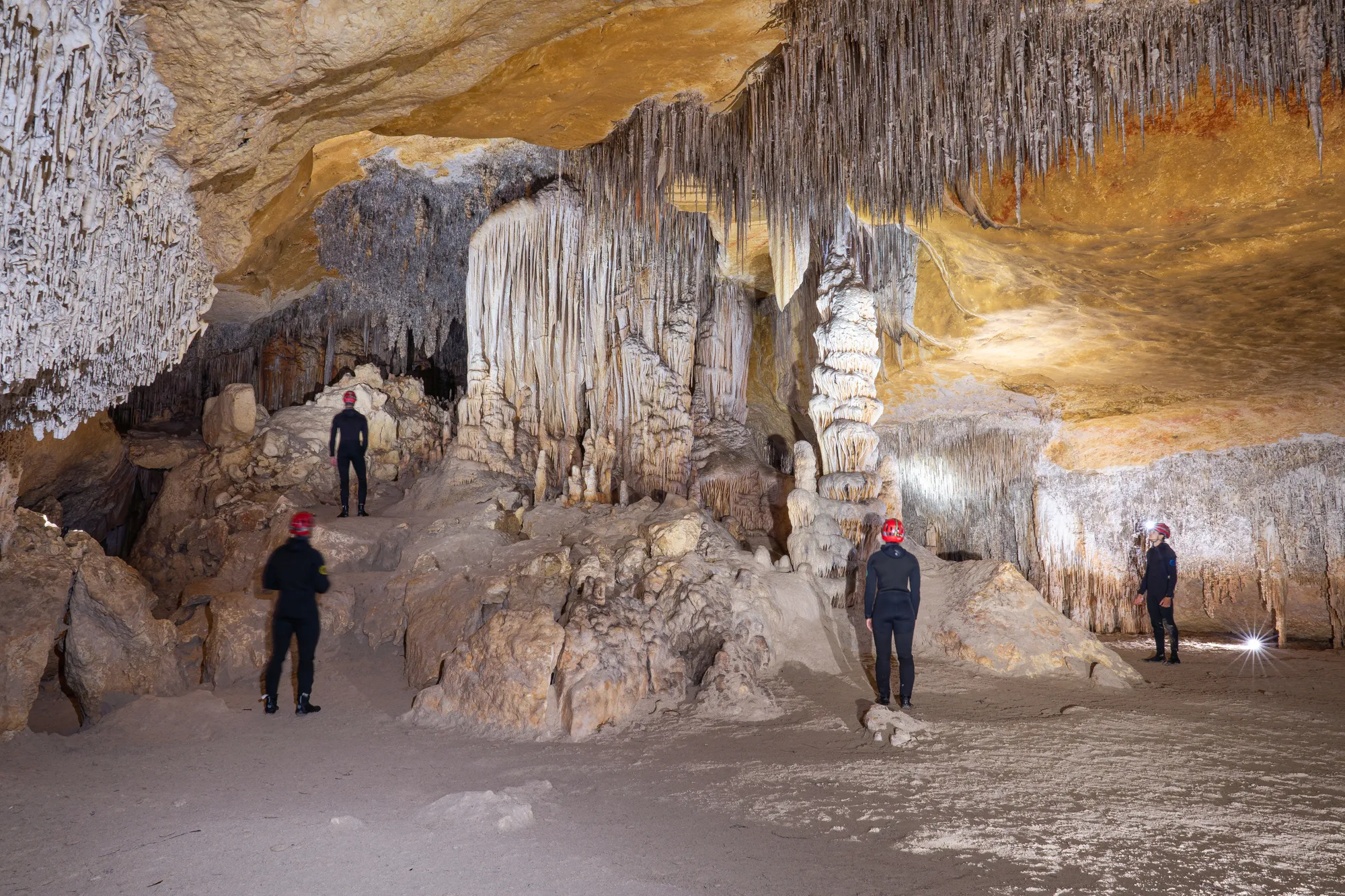
"Sea caving" covers a fairly specific kind of activity: entering a coastal cave from the water, then making your way through it on foot, by wading, or by swimming, depending on how flooded the chambers are. Most visitors wear a wetsuit, a helmet, and a waterproof headlamp, since many caves have no natural light beyond their entrance.
It's worth being clear about what it isn't. It isn't the same as visiting a show cave like the Cuevas del Drach, where you walk along paved, lit paths. It also isn't technical caving in the sense of ropes, harnesses, and crawling through tight, dry passages — the caves covered in this guide are accessed at sea level, in groups, with a guide. Think of it as a natural extension of snorkelling or coasteering, just with a roof overhead.
A typical visit involves swimming or wading from a boat or the shoreline into the cave mouth, then exploring one or more chambers — sometimes a tight passage, sometimes a space large enough to hold an underground lake — before returning the way you came.
How Mallorca's Limestone Coastline Created These Caves
Mallorca's east coast is built on relatively young limestone, laid down during the Miocene period as marine sediment and later uplifted above sea level. Because this rock is geologically young and porous — what geologists call eogenetic karst — it dissolves and erodes faster than older, denser limestone, creating extensive networks of voids, channels and chambers close to the surface.
Where these voids intersect both the sea and the island's freshwater table, you get anchialine caves: partially enclosed bodies of water that mix fresh groundwater with seawater. The result is often a visible halocline — a shimmering layer where the two types of water meet — and crystal-clear visibility above and below it. You can read more about what this looks and feels like in our guide to swimming inside a cave in Mallorca.
Many of these caves also preserve a record of past sea levels in their walls, in the form of mineral deposits known as phreatic overgrowths on speleothems. In plain terms: the rock itself tells a story, layer by layer, of how high the Mediterranean has risen and fallen over the last few hundred thousand years.
Where Mallorca's Sea Caves Are Found
The caves covered in this guide sit along the Llevant coast, the stretch of eastern Mallorca running roughly from Porto Cristo south toward Cala Mendia and Portocolom. This is the same area that produced the Cuevas del Drach and Cuevas dels Hams, two of the island's best-known show caves, both close to Porto Cristo.
Just south of Porto Cristo, the coastline becomes wilder: a series of coves including Cala Varques, Cala Anguila and Cala Romàntica, backed by pine forest and undeveloped limestone cliffs. It's in and around these coves that most of the accessible sea caves are found. Our guide to sea caves near Porto Cristo covers this area in more detail, including how to combine it with a visit to the show caves.
The Best-Known Sea Caves to Visit
Of the many caves along this coast, a small number stand out for being large, interesting, and realistically accessible to visitors with the right preparation. The most talked-about is Cova des Coloms, a partially open-roofed cave near Cala Varques with a substantial brackish pool inside. Nearby, a smaller cave sometimes called the "Pirate Cave" is popular with snorkellers exploring the cove independently.
Our guide to the best sea caves in Mallorca goes through these in more depth, including which caves are suitable for casual visitors and which require technical caving or diving qualifications that put them out of reach for most travellers.
Sea Caving vs the Drach Caves
If your trip already includes a visit to the Cuevas del Drach, it's worth knowing how different a sea caving experience is. The Drach Caves are a developed show cave: paved walkways, electric lighting, and a famous concert performed on boats on Lake Martel, viewed by large groups. Sea caving is the opposite in almost every respect — small groups, natural light, and an active, wetsuit-and-headlamp approach to exploring the cave yourself.
Neither is "better" in an absolute sense — they're different kinds of experience, and many visitors enjoy both as part of the same trip. Our page on sea caving vs the Drach Caves breaks down the practical differences in detail.
Getting There: On Foot or by Boat
There are two realistic ways to reach a cave like Cova des Coloms. The first is on foot: park near Cala Varques, walk roughly 30-40 minutes across exposed limestone terrain, then swim around 300 metres out to the cave entrance carrying a mask, fins and a light. It's achievable, but it's a serious undertaking in summer heat, and there's no shade, signage, or facilities along the way.
The second option is by boat — typically a small-group trip departing from Porto Cristo marina, cruising along the coast, and arriving at the cave entrance with a guide, wetsuit, helmet and light already sorted out. Our guide to sea cave tours in Mallorca compares both approaches in more detail.
A note on independent access
The land route to Cova des Coloms is not signposted as a tourist trail, has no facilities, and the swim to the cave entrance is in open water. If you're not an experienced open-water swimmer with appropriate gear, a guided trip is the more realistic option.
What to Bring and What's Provided
On a guided trip, the heavy gear — wetsuit, helmet, and waterproof headlamp — is provided. You'll mostly need to think about what to wear underneath, what to do with your phone, and what to bring for afterwards. Our packing list for a sea cave trip covers this in full.
Is Sea Caving Safe?
For most visitors, yes — provided you go with an established operator. The water inside these caves is calmer than the open sea, wetsuits provide buoyancy that makes floating easy, and guides monitor weather conditions before every trip. If you're weighing this up for yourself, your kids, or a less confident member of your group, our page on whether sea caving is safe goes through the real considerations.
The Recommended Way to Experience It
If you've read this far and want to see one of these caves for yourself, the option that best matches everything above — comfort, safety, and avoiding the coastal hike — is a guided boat trip from Porto Cristo.
Frequently Asked Questions
Most of the sea caves covered in this guide sit along the Llevant coast of Mallorca, between Porto Cristo and Cala Mendia, including the area around Cala Varques and Cala Anguila. This stretch of coastline is shaped by the same limestone platform that produced the famous Drach and Hams show caves further inland.
They are entirely natural. Mallorca's east coast sits on porous Miocene-era limestone. Over thousands of years, rainwater and seawater dissolved channels and chambers through the rock, eventually connecting some of these chambers to the sea. The result is a network of caves, some dry, some flooded, and some — like Cova des Coloms — partly open to the sky.
Yes, with the right preparation. The main physical requirement is being comfortable in open water while wearing a wetsuit, which actually makes floating easier, not harder. Most first-time visitors join a guided trip rather than attempting independent access — see our notes on safety and what to bring.
Start by reading about the best sea caves in Mallorca and the Cova des Coloms guide to understand what you'll see. Then check our safety guide and packing list before booking a trip. This order helps you arrive with realistic expectations and the right gear.
This guide is maintained independently of any tour operator — read more about how it's put together.
Continue exploring
The Best Sea Caves in Mallorca to Explore
An overview of the sea caves along the Llevant coast, including Cova des Coloms and the Pirate Cave at Cala Varques.
Read moreCova des Coloms, Mallorca: The Complete Sea Cave Guide
A full guide to Mallorca's Cova des Coloms — what's inside, how to reach it, and the Menorca name mix-up explained.
Read moreIs Sea Caving Safe? A Guide for Beginners and Families
A reassuring, practical look at the real safety considerations behind a guided sea cave trip.
Read more